
Categorizing films into genres can be a messy exercise. This is especially true when films seem to span across multiple categories (i.e., “dramedy”) or are purposefully “genre-busting.”
Is Star Wars sci-fi or fantasy? The Jedi and the force are fantasy. The Andor spin-off streaming series is more solidly in sci-fi. Lots of debates on Reddit and elsewhere about this. Some say “space opera,” but where’s the singing?
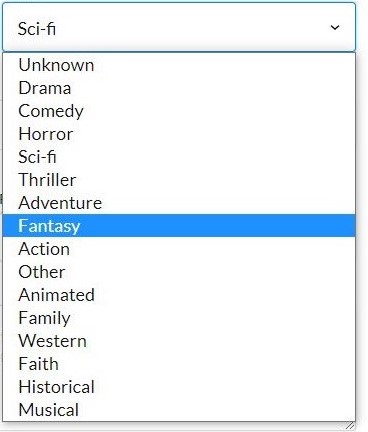
In practical terms, genre labels are only moderately useful to the audience anyway. Some screenwriting books blow these genres up and replace them with categories that make more sense from a storytelling perspective.
So why the fuss?
It’s a question filmmakers will have to at least consider for their projects at some point. Festivals, contests, and even IMDB will often require you to select a genre or genres for your film – sometimes, frustratingly, only allowing you to choose one.
For my projects, this can be a tough exercise. My stories are mostly dramas, but also a few comedies and family films. Still, all have strong sci-fi and faith elements. This is what makes them unique.
If I categorize them as dramas, they may not have a shot with sci-fi and faith audiences. And with dramas in secular film festivals, there may be an assumption that they are not family-friendly since most are not. Some are really not. Yet, I also wouldn’t select “family” for most of my projects (a couple are) as you’d normally think of films that are primarily written for kids to watch with their parents.
Festivals and contests often pair material up with readers or judges who specialize in the genre of the project. For this reason alone, it’s something that takes careful thought, however frustrating.
More and more, I’m seeing a “faith” option in the genre selection in secular film festivals. Although, many still do not have this, which is a testament to how far will still have to go. IMDB and Wikipedia do not include faith-based as a genre in their genre example lists.
Last year, this hit me head-on with a coverage package I received from one of the judges with a well-respected secular film festival.
He labeled my project as “fantasy.”
Really?! Hmm. Interesting.
I’ve never remotely considered my projects to be fantasy. The sci-fi elements are based solidly on a foundation of established science, with things that are not only possible but probable in the near future. And nothing in the story would be considered “miraculous,” though Christians would recognize the faith elements and assume God was behind them.
So what’s the deal?
In reflecting on this, I did a mental inventory of faith films and recognized that many faith-based projects have at least one or more “miracles” in the story. Something supernatural, beyond the physics of our world.
Recently, I watched a well-produced historical biopic about a Christian historical figure who lived within the last 100 years. From the very first two minutes of the film until the end, you sort of had to buy into at least five or six “fantastical” miracles, otherwise you weren’t going to enjoy the film. I’m a Christian, but even I frankly wasn’t buying into the miracles.
So was it fantasy? Faith-based? A fantastical, historical, faith-based, biopic drama? For people who are not believers in the Christian faith, and even some like me who are, I can see how they might label it as fantasy.
In the Christian space, The Chronicles of Narnia is clearly a fantasy with strong underlying faith themes. Narnia is about stepping into completely new worlds, somewhat detached from, but still resembling, our own. Everywhere Everything All at Once is similar, where this is a whole different world (or worlds), but still a tad grounded in real science. Is it fantasy or sci-fi? I think fantasy, but not enough time to go into why.
However, my projects are nowhere near Narnia or Everywhere. It’s solidly within the world we live in and you don’t even have to buy into any miracles or physics-busting worlds to enjoy the stories.
Yet, for some who are not believers in the Christian faith, I supposed any treatment of faith as having anything to do with the real world might be considered fantasy by them. Just the mere fact that my film had faith elements in it, even without any “miracles” per se, made it a fantasy to this one reader.
In this sort of approach, Jesus Revolution might also have to be considered fantasy. Still, while there were “miracles” performed by Lonnie Frisbee in the film, the filmmakers left some question marks on how they treated these incidents. Chuck Smith was portrayed as being skeptical and eventually discouraged Ronnie from attempting to evoke them. In real life, this led to somewhat of an in-house bible vs. spirit debate in the churches that spawned from that era.
But even with multiple miracles as core parts of the story in faith films, does that make them fantasy? Is The Chosen fantasy? If you don’t believe in all the many miracles in The Chosen, it’s going to be tough to invest person-days of your life into watching three plus seasons.
Here’s Wikipedia’s definition of fantasy: “Films defined by situations that transcend natural laws and/or by settings inside a fictional universe, with narratives that are often inspired by or involve human myths.”
Here’s IMDB’s: “Should contain numerous consecutive scenes of characters portrayed to effect a magical and/or mystical narrative throughout the title. Usually has elements of magic, supernatural events, mythology, folklore, or exotic fantasy worlds. Note: not to be confused with Sci-Fi which is not usually based in magic or mysticism.”
The fantasy label my project received from the film festival reader didn’t jive with what I’d consider any reasonable definition of fantasy. Hopefully, it’s just an isolated incident. All other secular and faith festivals have considered my projects to be what I would consider appropriate categories, usually drama or sci-fi, sometimes family, sometimes faith.
That reader also might just not have been very up-to-date with the science and tech in my project. I admit, as a former physics major and tech and science geek, I purposefully include a bit of advanced science and technology in my stories, beyond what they might get with your standard faith-based or drama fare. See Christopher Nolan.
At the same time, this experience made me look at faith films and their genre categorization with a fresh perspective.
While there may be some elements of fantasy in certain faith-based films, it is not appropriate to categorize all faith films as fantasy. While some faith-based films may include supernatural or miraculous events, these events are typically presented as a manifestation of faith and not as a complete departure from reality.
Labeling all faith-based films as fantasy ignores the nuances and complexities of the genre. Faith-based films can span multiple genres, including drama, comedy, romance, and even sci-fi, and often explore universal themes such as redemption, forgiveness, and hope.
The categorization of faith-based films should take into account the specific themes, tone, and audience of each film. While some films may be more fantastical in nature, others may be firmly grounded in reality and offer a realistic portrayal of faith and spirituality.
Ultimately, the goal of genre categorization should be to help audiences find the films that resonate with them and provide a meaningful viewing experience. It is important for filmmakers to carefully consider the genre categorization of their films, but it is also important for audiences to approach these categorizations with an open mind and a willingness to explore the unique perspectives and themes presented in each film.
I’d be interested to hear your thoughts in the comments.


 Multiverse Hacking
Leave a comment